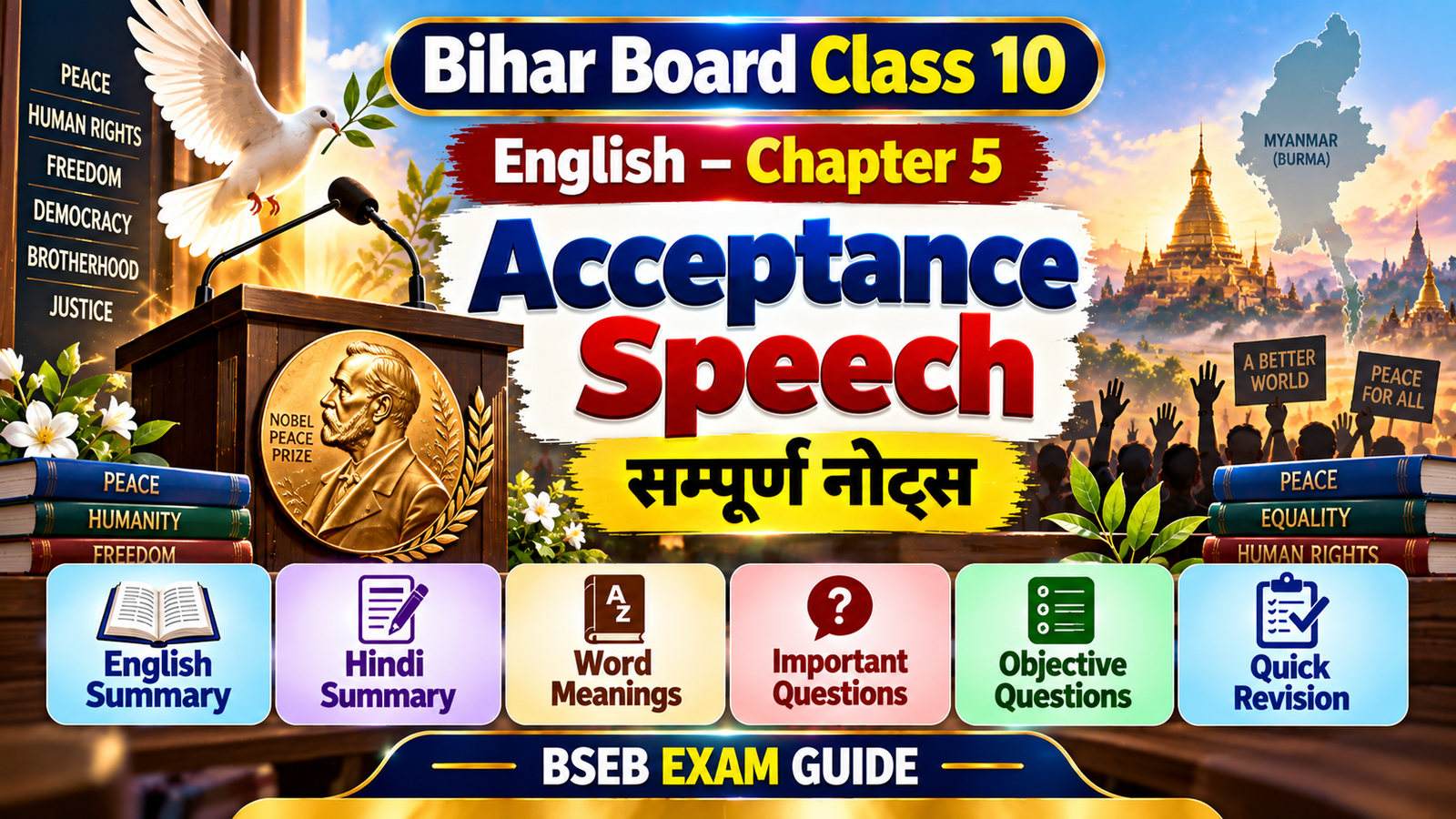
Acceptance Speech
Chapter 5 – सम्पूर्ण नोट्स
English Summary • हिंदी सारांश • Important Q&A
Chapter Introduction
Acceptance Speech शांति, मानवाधिकार, स्वतंत्रता और मानवीय गरिमा से संबंधित एक महत्वपूर्ण पाठ है।
यह पाठ Aung San Suu Kyi को मिले Nobel Peace Prize से संबंधित acceptance speech पर आधारित है। उस समय वे स्वयं समारोह में उपस्थित नहीं हो सकीं, इसलिए उनके पुत्र Alexander Aris ने उनकी ओर से पुरस्कार स्वीकार करते हुए speech दिया।
सच्ची शांति केवल युद्ध का अभाव नहीं है। मानवाधिकार, स्वतंत्रता, न्याय और भाईचारा भी स्थायी शांति के लिए आवश्यक हैं।
इस Chapter में पढ़ेंगे
1. Background of the Chapter
Aung San Suu Kyi belongs to Burma (Myanmar). She became internationally known for her association with the movement for democracy and human rights in her country.
She received the Nobel Peace Prize. As she could not personally attend the award ceremony, her son Alexander Aris accepted the award on her behalf and delivered the acceptance speech.
The speech draws attention not only to Aung San Suu Kyi but also to the suffering of the people of Burma and to the universal need for peace, freedom and human dignity.
2. English Summary
Acceptance Speech – Summary in English
“Acceptance Speech” is connected with the Nobel Peace Prize awarded to Aung San Suu Kyi for her peaceful struggle associated with democracy and human rights in Burma.
Since Aung San Suu Kyi could not personally attend the Nobel ceremony, her son Alexander Aris accepted the prize on her behalf and delivered the speech.
In the speech, Alexander expresses gratitude for the honour given to his mother. At the same time, he makes it clear that the award represents something larger than one individual.
The suffering of the people of Burma is brought before the world. The speech refers to people facing hardship, illness, displacement and violations of basic human dignity.
The speech also remembers Buddhist monks who had suffered humiliation and violence. Their suffering becomes part of the larger struggle for freedom and human rights.
The ideas of peace and universal brotherhood are central to the speech. It refers to the belief that humanity should move away from racism, war, oppression and hatred.
The speech emphasizes that genuine brotherhood and peace are more precious than material wealth such as diamonds, silver or gold.
Thus, the acceptance of the Nobel Peace Prize becomes an appeal to the international community to support peace, justice, freedom and human dignity everywhere.
3. हिंदी सारांश
Acceptance Speech – आसान हिंदी सारांश
Acceptance Speech Aung San Suu Kyi को मिले Nobel Peace Prize से संबंधित पाठ है। उन्होंने Burma में लोकतांत्रिक अधिकारों और मानवाधिकारों से जुड़े संघर्ष के कारण अंतरराष्ट्रीय पहचान प्राप्त की।
Aung San Suu Kyi स्वयं Nobel Prize समारोह में उपस्थित नहीं हो सकीं। इसलिए उनके पुत्र Alexander Aris ने उनकी ओर से पुरस्कार स्वीकार किया और acceptance speech दिया।
Alexander अपने भाषण में इस सम्मान के लिए आभार व्यक्त करते हैं। लेकिन वे यह भी बताते हैं कि यह सम्मान केवल उनकी माँ के लिए नहीं, बल्कि Burma के उन सभी लोगों के संघर्ष का प्रतीक है जो कठिन परिस्थितियों का सामना कर रहे थे।
भाषण में Burma के लोगों की पीड़ा का उल्लेख किया गया है। जंगलों में कठिन जीवन बिताने वाले लोग बीमारी और अभाव का सामना कर रहे थे। मानवाधिकारों के उल्लंघन और लोगों की कठिन परिस्थितियों पर भी ध्यान आकर्षित किया गया है।
पाठ में Buddhist monks के साथ हुए दुर्व्यवहार और अपमान का भी उल्लेख आता है। इससे यह स्पष्ट होता है कि संघर्ष केवल किसी एक व्यक्ति का नहीं, बल्कि अनेक लोगों के अधिकार और सम्मान का था।
भाषण का सबसे महत्वपूर्ण संदेश शांति और भाईचारा है। मानव समाज को युद्ध, नस्लीय भेदभाव, हिंसा और नफरत से ऊपर उठना चाहिए।
सच्चा भाईचारा और शांति किसी भी भौतिक संपत्ति से अधिक मूल्यवान हैं। वे diamonds, silver या gold से भी अधिक कीमती हैं।
इस प्रकार यह भाषण हमें मानवाधिकारों का सम्मान करने, अन्याय के विरुद्ध खड़े होने और विश्व में स्थायी शांति तथा भाईचारे को बढ़ावा देने का संदेश देता है।
4. आसान हिंदी में Explanation
Nobel Peace Prize का महत्व
यह पुरस्कार केवल किसी व्यक्ति की व्यक्तिगत उपलब्धि का सम्मान नहीं था। Speech इसे Burma के लोगों के संघर्ष और उनकी आशाओं से जोड़ता है।
Burma के लोगों की पीड़ा
Speech दुनिया का ध्यान उन लोगों की ओर खींचता है जो कठिन परिस्थितियों में रह रहे थे। अनेक लोग बीमारी, विस्थापन और असुरक्षा का सामना कर रहे थे।
Speech का उद्देश्य केवल पुरस्कार स्वीकार करना नहीं, बल्कि Burma के लोगों की स्थिति को अंतरराष्ट्रीय समुदाय के सामने रखना भी था।
Human Rights
हर व्यक्ति को सम्मान और बुनियादी अधिकार मिलने चाहिए। किसी व्यक्ति को उसकी स्वतंत्रता और मानवीय गरिमा से वंचित करना शांति की भावना के विरुद्ध है।
Peace and Brotherhood
Speech का संदेश केवल Burma तक सीमित नहीं रहता। यह पूरी मानवता के लिए शांति और भाईचारे की बात करता है।
मानव समाज को racism, violence और war से आगे बढ़कर आपसी सम्मान और सहयोग की दिशा में जाना चाहिए।
Material Wealth से बड़ी चीज
धन, सोना, चाँदी और हीरे मूल्यवान हो सकते हैं, लेकिन सच्ची शांति और मानवीय भाईचारा उनसे कहीं अधिक महत्वपूर्ण हैं।
Peace + Freedom + Human Rights + Brotherhood = Better Humanity
5. Main Themes
Peace
विश्व में स्थायी शांति की आवश्यकता।
Human Rights
हर व्यक्ति के मूल अधिकारों का सम्मान।
Freedom
मनुष्य के लिए स्वतंत्रता का महत्व।
Brotherhood
पूरी मानवता के बीच भाईचारा।
Human Dignity
प्रत्येक व्यक्ति के सम्मान की रक्षा।
Non-Violence
समस्याओं के शांतिपूर्ण समाधान पर जोर।
6. Exam Important Points
1. Acceptance Speech is associated with Aung San Suu Kyi.
2. Aung San Suu Kyi belongs to Burma (Myanmar).
3. She received the Nobel Peace Prize.
4. Alexander Aris delivered the acceptance speech on her behalf.
5. The acceptance speech was delivered in 1991.
6. Aung San Suu Kyi also received the Rafto Prize and Sakharov Prize.
7. The speech draws attention to the suffering of the people of Burma.
8. Buddhist monks are mentioned in the lesson.
9. Peace and human rights are central ideas of the chapter.
10. International Human Rights Day is observed on 10 December.
11. The lesson refers to Martin Luther King Jr.’s vision of humanity moving beyond racism and war.
12. Genuine brotherhood and peace are described as more precious than diamonds, silver or gold.
7. Important Word Meanings
8. Important Short Answer Questions
Q1. Who is associated with “Acceptance Speech”?
Answer: Aung San Suu Kyi is associated with “Acceptance Speech”.
Q2. Which country does Aung San Suu Kyi belong to?
Answer: She belongs to Burma (Myanmar).
Q3. Which Nobel Prize was awarded to Aung San Suu Kyi?
Answer: She was awarded the Nobel Peace Prize.
Q4. Who delivered the acceptance speech?
Answer: Alexander Aris delivered the acceptance speech on behalf of his mother.
Q5. When was the acceptance speech delivered?
Answer: It was delivered in 1991.
Q6. Who were mentioned as having been beaten and dishonoured?
Answer: Buddhist monks were mentioned as having been beaten and dishonoured.
Q7. What does “applaud” mean?
Answer: “Applaud” means to praise or show approval.
Q8. When is International Human Rights Day observed?
Answer: It is observed on 10 December.
Q9. What is more precious than diamonds, silver or gold?
Answer: Genuine brotherhood and peace are more precious than diamonds, silver or gold.
Q10. What are the central values of the speech?
Answer: Peace, freedom, human rights, dignity and brotherhood are its central values.
Q11. Whose words about racism and war are referred to in the lesson?
Answer: The lesson refers to Martin Luther King Jr.
Q12. What is the main message of the chapter?
Answer: Its main message is that humanity should work for peace, freedom, human rights and universal brotherhood.
9. Important Long Answer Questions
Q1. Write the summary of “Acceptance Speech”.
Answer:
“Acceptance Speech” is associated with the Nobel Peace Prize awarded to Aung San Suu Kyi. As she could not attend the ceremony personally, her son Alexander Aris accepted the award on her behalf.
The speech expresses gratitude for the honour but also draws the world’s attention to the suffering of the people of Burma. It emphasizes human rights, freedom and dignity.
The speech presents peace and genuine brotherhood as values greater than material wealth. Its message goes beyond Burma and appeals for a more peaceful and humane world.
Q2. What message does “Acceptance Speech” give?
Answer:
The speech gives a universal message of peace, freedom, human dignity and brotherhood. It reminds us that peace cannot exist where people are denied their basic rights.
It encourages humanity to move away from violence, racism, oppression and war and work towards justice and mutual respect.
Q3. Why are peace and brotherhood more precious than material wealth?
Answer:
Material wealth can provide comfort, but it cannot replace freedom, security and human dignity.
Peace and brotherhood allow people to live together without fear, violence or hatred. Therefore, they are more valuable for humanity than diamonds, silver or gold.
Q4. How does the speech connect Aung San Suu Kyi’s award with the people of Burma?
Answer:
The speech does not present the award merely as a personal honour. It connects the prize with the suffering and aspirations of the people of Burma.
By discussing their hardships and struggle for basic rights, the speech turns the Nobel ceremony into an appeal for international attention, peace and human dignity.
10. Objective Questions
1. “Acceptance Speech” is associated with —
A. Toni Morrison
B. Aung San Suu Kyi
C. Mahadevi Verma
D. Satyajit Ray
2. Aung San Suu Kyi belongs to —
A. China
B. Burma
C. Nepal
D. Bhutan
3. She received the Nobel Prize for —
A. Literature
B. Physics
C. Peace
D. Medicine
4. Who delivered the Acceptance Speech?
A. Alexander Aris
B. Satyajit Ray
C. U Thant
D. Martin Luther King Jr.
5. The Acceptance Speech was delivered in —
A. 1990
B. 1991
C. 1993
D. 1995
6. Who were beaten and dishonoured?
A. Buddhist monks
B. Scientists
C. Writers
D. Teachers
7. “Applaud” means —
A. To curse
B. To praise
C. To control
D. To discourage
8. International Human Rights Day is observed on —
A. 5 December
B. 10 December
C. 20 December
D. 30 December
9. Who is referred to in connection with the “starless midnight” of racism and war?
A. Martin Luther King Jr.
B. Satyajit Ray
C. Mahadevi Verma
D. Joan Lexau
10. What is more precious than diamonds, silver or gold?
A. Money
B. Power
C. Brotherhood and peace
D. Fame
11. The central subject of the speech is —
A. Business
B. Peace and human rights
C. Cinema
D. Ecology
12. Aung San Suu Kyi also received —
A. Rafto Prize
B. Sakharov Prize
C. Both A and B
D. Neither
11. Quick Revision
Person
Aung San Suu Kyi
Country
Burma (Myanmar)
Award
Nobel Peace Prize
Speech
Alexander Aris
Year
1991
Main Issue
Human Rights
Human Rights Day
10 December
Key Value
Freedom
Precious
Peace & Brotherhood
Message
Peace for Humanity
Exam Tip
Aung San Suu Kyi, Burma, Nobel Peace Prize, Alexander Aris, 1991, Buddhist monks, Martin Luther King Jr., 10 December, human rights और “brotherhood and peace” वाले points विशेष रूप से तैयार करें।