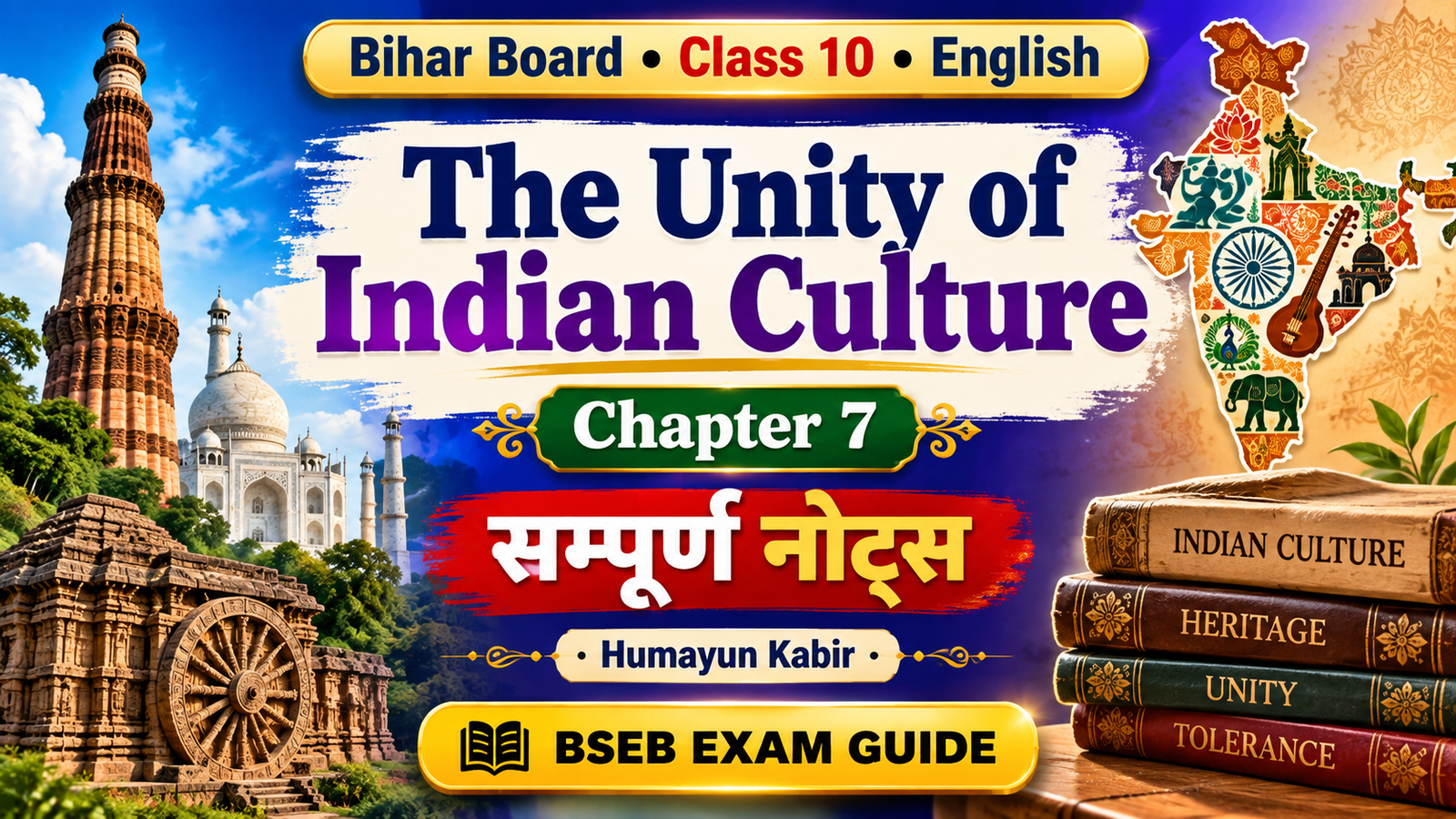
The Unity of Indian Culture
Chapter 7 – सम्पूर्ण नोट्स
Humayun Kabir • English Summary • हिंदी सारांश • Important Q&A
Chapter Introduction
The Unity of Indian Culture is an important essay by Humayun Kabir. The chapter discusses the richness, continuity and remarkable vitality of Indian culture.
लेखक बताते हैं कि भारत की संस्कृति किसी एक समय, जाति या समुदाय की देन नहीं है। अनेक समूहों, विचारों और परंपराओं ने इसके विकास में योगदान दिया।
भारत ने समय-समय पर आने वाले विभिन्न सांस्कृतिक प्रभावों को केवल स्वीकार ही नहीं किया, बल्कि उन्हें अपने व्यापक सांस्कृतिक जीवन का हिस्सा भी बनाया।
Indian culture has maintained unity through continuity, tolerance, adaptability and the ability to absorb diverse influences.
इस Chapter में पढ़ेंगे
1. About Humayun Kabir
Humayun Kabir was a poet, novelist, essayist and political thinker.
The present chapter is based on a lecture associated with his discussion of India’s cultural heritage.
इस पाठ में उनका भारतीय संस्कृति की महानता, उसकी निरंतरता तथा विविधताओं के बीच एकता के प्रति गहरा विश्वास दिखाई देता है।
2. English Summary
The Unity of Indian Culture – Summary in English
In “The Unity of Indian Culture”, Humayun Kabir discusses the long history, vitality and continuity of Indian culture.
India has witnessed the arrival and interaction of different groups and traditions over a very long period. These contacts contributed to the development of Indian civilisation and culture.
The author points out that Indian civilisation did not remain completely unchanged. It continued to grow and change while preserving a remarkable continuity with its past.
This ability to change without completely breaking with the past is one of the important characteristics of Indian culture.
The chapter also makes an important distinction between civilisation and culture. Material progress alone does not necessarily create a rich culture.
Culture represents a deeper development of human life. It is connected with values, ideas, attitudes, creativity and ways of living.
One of the great strengths of Indian culture is its capacity to accept different influences and make them part of a larger cultural tradition.
Tolerance has therefore played an important role in Indian cultural life. The idea of “live and let live” reflects this spirit.
India’s cultural unity does not mean that everyone follows exactly the same customs. Rather, unity exists along with diversity.
The essay ultimately presents the unbroken continuity, adaptability and tolerance of Indian culture as major reasons for its lasting vitality.
3. हिंदी सारांश
The Unity of Indian Culture – आसान हिंदी सारांश
“The Unity of Indian Culture” में Humayun Kabir ने भारतीय संस्कृति की प्राचीनता, निरंतरता, सहिष्णुता और जीवंतता की चर्चा की है।
भारत का इतिहास बहुत पुराना है। अलग-अलग समय में अनेक समूह और परंपराएँ भारतीय जीवन के संपर्क में आईं। इन सभी संपर्कों ने भारतीय सभ्यता और संस्कृति के विकास में योगदान दिया।
भारतीय संस्कृति की सबसे बड़ी विशेषताओं में से एक यह है कि उसने परिवर्तन को स्वीकार किया, लेकिन अपने अतीत से संबंध पूरी तरह नहीं तोड़ा।
समय के साथ भारतीय सभ्यता और संस्कृति बदलती और विकसित होती रही, फिर भी उसकी सांस्कृतिक निरंतरता बनी रही।
लेखक civilisation और culture में अंतर भी बताते हैं। केवल भौतिक उन्नति को संस्कृति नहीं कहा जा सकता।
संस्कृति मनुष्य के विचारों, मूल्यों, जीवन-दृष्टि, कला, व्यवहार और रचनात्मकता से जुड़ी होती है।
भारतीय संस्कृति ने बाहर से आने वाले अनेक प्रभावों को अपने भीतर स्थान दिया। इससे भारतीय संस्कृति समाप्त नहीं हुई, बल्कि और अधिक समृद्ध हुई।
सहिष्णुता भारतीय संस्कृति की महत्वपूर्ण विशेषता है। अलग-अलग विचारों और जीवन-पद्धतियों के प्रति सम्मान की भावना ने भारत की सांस्कृतिक एकता को मजबूत किया।
यहाँ एकता का अर्थ सभी लोगों का बिल्कुल समान होना नहीं है। भारत में अनेक भाषाएँ, परंपराएँ और जीवन-पद्धतियाँ होते हुए भी एक व्यापक सांस्कृतिक संबंध दिखाई देता है।
भारतीय संस्कृति की शक्ति उसकी विविधता को स्वीकार करने, बदलते समय के साथ विकसित होने और अपनी सांस्कृतिक निरंतरता बनाए रखने में है।
4. Detailed Explanation
भारत की प्राचीन सांस्कृतिक परंपरा
भारत की सभ्यता और संस्कृति बहुत प्राचीन है। इतिहास के अलग-अलग चरणों में अनेक लोगों और परंपराओं का भारतीय जीवन से संपर्क हुआ।
इसलिए भारतीय संस्कृति को केवल एक समूह के योगदान के रूप में देखना उचित नहीं है। यह लंबे ऐतिहासिक विकास का परिणाम है।
Aryans and Earlier Civilisation
पाठ में Aryans तथा उनसे पहले मौजूद सभ्यता के बारे में ऐतिहासिक विचारों की चर्चा की गई है।
इससे लेखक यह दिखाते हैं कि भारतीय civilisation का विकास कई ऐतिहासिक परतों और सांस्कृतिक संपर्कों से हुआ।
Continuous Growth
Indian culture की एक महत्वपूर्ण विशेषता उसका लगातार विकसित होना है। यह स्थिर नहीं रही बल्कि परिस्थितियों के अनुसार बदलती रही।
Change और continuity दोनों भारतीय संस्कृति के विकास में साथ-साथ दिखाई देते हैं।
Absorbing Different Influences
भारत के सांस्कृतिक इतिहास में अलग-अलग समूहों और विचारों का प्रभाव पड़ा। भारतीय संस्कृति की विशेषता यह रही कि उसने इनमें से अनेक प्रभावों को अपने भीतर समाहित कर लिया।
इस प्रक्रिया से विविधता बढ़ी, लेकिन व्यापक सांस्कृतिक संबंध भी बना रहा।
Tolerance
Tolerance अर्थात सहिष्णुता भारतीय संस्कृति की महत्वपूर्ण विशेषताओं में है। इसका अर्थ है दूसरे के विचार, विश्वास और जीवन-पद्धति के अस्तित्व को स्वीकार करना।
“Live and let live” इसी भावना को व्यक्त करता है।
Unity in Diversity
भारत की एकता का अर्थ एकरूपता नहीं है। अलग-अलग भाषा, परंपरा और रीति-रिवाज के बावजूद लोग एक व्यापक सांस्कृतिक विरासत से जुड़े हैं।
Indian cultural unity survives not by removing diversity, but by accommodating and connecting diverse traditions.
5. Culture and Civilisation
Civilisation
सभ्यता मानव समाज की सामाजिक और भौतिक प्रगति से जुड़ी होती है।
इसमें जीवन की बाहरी व्यवस्थाएँ और उपलब्धियाँ शामिल हो सकती हैं।
Culture
Culture मनुष्य के विचार, मूल्य, कला, व्यवहार और जीवन-दृष्टि से जुड़ी है।
यह civilisation की गहरी मानवीय और रचनात्मक अभिव्यक्ति को दर्शाती है।
Chapter में culture को civilisation की “efflorescence” के रूप में समझाया गया है।
6. Features of Indian Culture
Continuity
भारतीय संस्कृति ने अपने अतीत से लंबे समय तक संबंध बनाए रखा।
Vitality
समय के साथ बदलते हुए भी इसकी जीवंतता बनी रही।
Tolerance
अलग-अलग विचारों और परंपराओं के लिए स्थान रहा।
Adaptability
इसने बदलती परिस्थितियों के अनुसार स्वयं को विकसित किया।
Assimilation
अनेक बाहरी प्रभावों को अपने व्यापक स्वरूप में समाहित किया।
Unity
विविधताओं के बीच व्यापक सांस्कृतिक संबंध बनाए रखा।
7. Main Themes
विविधताओं के बीच सांस्कृतिक संबंध।
प्राचीन काल से चली आ रही सांस्कृतिक धारा।
दूसरे विचारों और परंपराओं के प्रति स्वीकार्यता।
समय के साथ संस्कृति का विकसित होना।
अलग-अलग प्रभावों को अपने भीतर समाहित करना।
भारत की समृद्ध सांस्कृतिक विरासत।
8. Exam Important Points
1. The essay is written by Humayun Kabir.
2. The chapter discusses the richness of Indian culture.
3. The Aryans were once regarded as the earliest invaders of India.
4. Other groups came into contact with India in later historical periods.
5. Indian civilisation continued to grow and change.
6. Indian culture is known for remarkable continuity.
7. Culture and civilisation are related but not identical.
8. Culture is described as the efflorescence of civilisation.
9. Tolerance is an important characteristic of culture.
10. “Live and let live” expresses the spirit of tolerance.
11. Indian culture accepted and absorbed different influences.
12. Diversity does not necessarily destroy cultural unity.
13. Adaptability helped Indian culture remain vibrant.
14. Unbroken continuity is a major feature emphasized in the chapter.
9. Important Word Meanings
10. Important Short Answer Questions
Q1. Who wrote “The Unity of Indian Culture”?
Answer: Humayun Kabir wrote “The Unity of Indian Culture”.
Q2. What is the main subject of the chapter?
Answer: The chapter deals with the richness, continuity and unity of Indian culture.
Q3. Who were once regarded as the earliest invaders of India?
Answer: The Aryans were once regarded as the earliest invaders of India.
Q4. Did Indian civilisation remain completely unchanged?
Answer: No. It continued to grow and change while maintaining continuity with its past.
Q5. What is a major distinguishing feature of Indian culture?
Answer: Its remarkable unbroken continuity is a major distinguishing feature.
Q6. What is culture?
Answer: Culture represents the deeper development of human values, ideas, creativity and ways of life.
Q7. How is culture related to civilisation?
Answer: The chapter describes culture as the efflorescence of civilisation.
Q8. What is an important characteristic of culture?
Answer: Tolerance is an important characteristic of culture.
Q9. What does “Live and let live” suggest?
Answer: It suggests tolerance and respect for the existence of different ways of life.
Q10. What is meant by cultural continuity?
Answer: Cultural continuity means maintaining a connection with the past while continuing to develop over time.
Q11. How did Indian culture deal with different influences?
Answer: Indian culture accepted and assimilated many different influences into its broader tradition.
Q12. What is the central message of the essay?
Answer: Indian culture has remained strong through continuity, tolerance, adaptability and cultural assimilation.
11. Important Long Answer Questions
Q1. Write a summary of “The Unity of Indian Culture”.
Answer:
“The Unity of Indian Culture” by Humayun Kabir discusses the long continuity and vitality of Indian culture. Indian civilisation has developed through interaction among different peoples and traditions.
It did not remain completely unchanged. It developed with time while maintaining a connection with its past.
The author also emphasizes tolerance and the ability to absorb different influences. Thus, continuity, adaptability and tolerance are major strengths of Indian culture.
Q2. What are the main characteristics of Indian culture?
Answer:
Indian culture is marked by continuity, vitality, tolerance and adaptability. It has survived for a long period while continuously changing and developing.
Another important quality is its capacity to assimilate different cultural influences. Diversity has therefore become part of India’s wider cultural unity.
Q3. Explain the difference between culture and civilisation.
Answer:
Civilisation generally refers to the organised and material development of human society, while culture represents deeper human values, ideas, creativity and ways of life.
Material development alone does not necessarily create culture. The chapter therefore presents culture as the deeper flowering or efflorescence of civilisation.
Q4. Explain the role of tolerance in Indian culture.
Answer:
Tolerance allows different ideas, beliefs and traditions to exist together. It has helped Indian society accommodate diversity over long periods.
The spirit expressed in “live and let live” encourages coexistence instead of forcing complete uniformity. This has contributed to India’s cultural continuity and unity.
Q5. How can unity and diversity exist together in Indian culture?
Answer:
Cultural unity does not require every person to speak the same language or follow identical customs. India contains many traditions and ways of life.
At the same time, long historical interaction, shared cultural experiences, tolerance and assimilation have created wider connections among these different traditions. Thus diversity and unity can exist together.
12. Objective Questions
1. Who wrote “The Unity of Indian Culture”?
A. Toni Morrison
B. Humayun Kabir
C. Satyajit Ray
D. Mahadevi Verma
2. “The Unity of Indian Culture” is mainly an —
A. Essay
B. Drama
C. Novel
D. Short story
3. The chapter mainly discusses the glorious heritage of —
A. European culture
B. Indian culture
C. American culture
D. Japanese culture
4. Who were once regarded as the earliest invaders?
A. Aryans
B. British
C. Portuguese
D. French
5. Indian civilisation and culture have —
A. Never changed
B. Grown and changed
C. Completely disappeared
D. Remained isolated
6. Culture is the ______ of civilisation.
A. Destruction
B. Efflorescence
C. Enemy
D. End
7. What specially distinguishes Indian culture?
A. Broken continuity
B. Unbroken continuity
C. Isolation
D. Uniformity
8. A common characteristic emphasized in the chapter is —
A. Tolerance
B. Anger
C. Isolation
D. Conflict
9. “Live and let live” expresses the idea of —
A. Conflict
B. Tolerance
C. Competition
D. Isolation
10. Indian culture is notable for its —
A. Continuity
B. Complete isolation
C. Lack of history
D. Uniformity only
11. Indian culture has absorbed —
A. Different influences
B. No outside influence
C. Only one tradition
D. Only modern ideas
12. Humayun Kabir emphasizes the vitality of —
A. Indian culture
B. Film industry
C. Modern machines
D. Western cinema
13. Indian culture changed with —
A. Time
B. Nothing
C. One event only
D. One ruler only
14. Cultural unity can exist with —
A. Diversity
B. No traditions
C. Isolation only
D. No change
15. The chapter presents Indian cultural heritage as —
A. Rich and continuous
B. Completely lost
C. Very recent
D. Unimportant
13. Quick Revision
Author
Humayun Kabir
Subject
Indian Culture
Key Quality
Continuity
Core Value
Tolerance
Policy
Live and Let Live
Strength
Adaptability
Process
Assimilation
Culture
Efflorescence of Civilisation
Special Feature
Unbroken Continuity
Main Message
Unity in Diversity
Exam Tip
Humayun Kabir, Indian culture, Aryans, civilisation, culture, efflorescence, tolerance, “Live and let live”, unbroken continuity, assimilation और cultural unity को विशेष रूप से याद करें।