
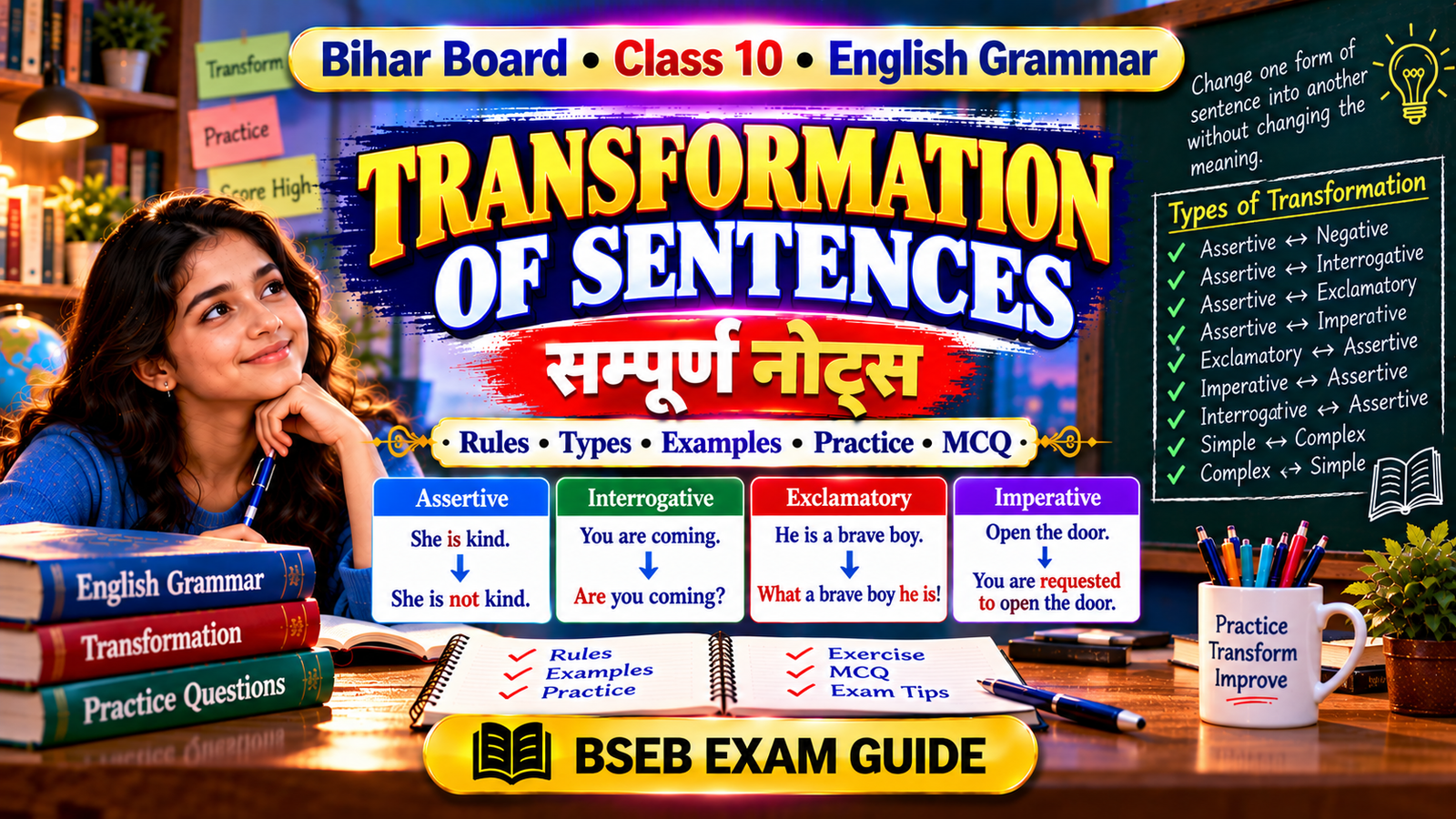
Transformation of Sentences
सम्पूर्ण नोट्स
Rules • Types • Examples • Practice • MCQ
1. Transformation of Sentences क्या है?
किसी sentence के meaning को बदले बिना उसके grammatical form या structure को बदलना Transformation of Sentences कहलाता है।
Assertive: He is a very intelligent boy.
Exclamatory: What an intelligent boy he is!
दोनों sentences का मूल अर्थ लगभग समान है, लेकिन उनका grammatical form अलग है।
2. मुख्य प्रकार
कथन
नकारात्मक
प्रश्नवाचक
विस्मयादिबोधक
आज्ञा/अनुरोध
सरल वाक्य
मिश्र वाक्य
संयुक्त वाक्य
3. Affirmative to Negative
Affirmative sentence को negative बनाते समय केवल not जोड़ देना काफी नहीं है। Meaning को समान रखना आवश्यक है।
Affirmative: He is always punctual.
Negative: He is never late.
Affirmative: Everyone loves freedom.
Negative: There is no one who does not love freedom.
4. Only → None But / Nothing But
Only वाले sentences को negative form में बदलने का यह महत्वपूर्ण तरीका है।
Only + Person → None but
Only + Thing → Nothing but
Only Ravi knew the answer.
→ None but Ravi knew the answer.
He wants only money.
→ He wants nothing but money.
5. As Soon As → No Sooner…Than
Original: As soon as the teacher entered, the students became silent.
Transformation: No sooner did the teacher enter than the students became silent.
6. Too…To → So…That
↓
So + Adjective + That + Subject + Cannot/Could Not
He is too weak to walk.
→ He is so weak that he cannot walk.
He was too tired to continue.
→ He was so tired that he could not continue.
7. Assertive to Interrogative
Assertive sentence को interrogative में बदलते समय meaning को बनाए रखना चाहिए।
Assertive: Everyone loves freedom.
Interrogative: Who does not love freedom?
Assertive: Nobody can deny this truth.
Interrogative: Who can deny this truth?
8. Interrogative to Assertive
Interrogative: Who does not know Mahatma Gandhi?
Assertive: Everyone knows Mahatma Gandhi.
Interrogative: Can anyone live without water?
Assertive: No one can live without water.
9. Assertive to Exclamatory
यदि sentence में very + adjective हो, तो उसे What/How के माध्यम से exclamatory sentence में बदला जा सकता है।
She is a very beautiful girl.
→ What a beautiful girl she is!
The flower is very beautiful.
→ How beautiful the flower is!
10. What और How का प्रयोग
What
What + a/an + adjective + singular countable noun + subject + verb!
What a beautiful flower it is!
How
How + adjective/adverb + subject + verb!
How beautiful the flower is!
11. Exclamatory to Assertive
Exclamatory: What a beautiful flower it is!
Assertive: It is a very beautiful flower.
Exclamatory: How clever the boy is!
Assertive: The boy is very clever.
12. Alas! → It Is Very Sad That…
Exclamatory: Alas! He is dead.
Assertive: It is very sad that he is dead.
13. Hurrah! → It Is a Matter of Joy…
Exclamatory: Hurrah! We have won the match.
Assertive: It is a matter of joy that we have won the match.
14. Imperative to Assertive
Imperative sentence में subject सामान्यतः hidden you होता है।
Imperative: Obey your parents.
Assertive: You should obey your parents.
Imperative: Never tell a lie.
Assertive: You should never tell a lie.
15. Request वाले Imperative
Imperative: Please help me.
Assertive: You are requested to help me.
Imperative: Please open the door.
Assertive: You are requested to open the door.
16. Simple, Complex और Compound Sentence
Simple
एक मुख्य finite clause वाला structure.
Being tired, he slept.
Complex
Main Clause + Subordinate Clause.
As he was tired, he slept.
Compound
दो या अधिक coordinate independent clauses.
He was tired, so he slept.
17. Simple → Complex
Simple: Being ill, he could not attend school.
Complex: As he was ill, he could not attend school.
Simple: In spite of his poverty, he is honest.
Complex: Though he is poor, he is honest.
18. Complex → Simple
Complex: When he saw the police, he ran away.
Simple: On seeing the police, he ran away.
Complex: Though he was poor, he was honest.
Simple: In spite of his poverty, he was honest.
19. Simple → Compound
Simple: Being tired, he went to bed.
Compound: He was tired, so he went to bed.
Simple: In spite of being poor, he is honest.
Compound: He is poor, but he is honest.
20. Compound → Simple
Compound: He worked hard and succeeded.
Simple: By working hard, he succeeded.
Compound: He was ill, so he stayed at home.
Simple: Being ill, he stayed at home.
21. Complex → Compound
Complex: Though he is poor, he is honest.
Compound: He is poor, but he is honest.
Complex: As he was tired, he took rest.
Compound: He was tired, so he took rest.
22. Compound → Complex
Compound: Work hard or you will fail.
Complex: If you do not work hard, you will fail.
Compound: He was poor, but he was honest.
Complex: Though he was poor, he was honest.
23. Despite / In Spite Of → Though / Although
↕
Though / Although + Clause
In spite of his poverty, he is happy.
→ Though he is poor, he is happy.
Despite working hard, he failed.
→ Although he worked hard, he failed.
24. Because Of → Because
↕
Because + Clause
He stayed home because of his illness.
→ He stayed home because he was ill.
25. Without → If…Not
Simple: Without working hard, you cannot succeed.
Complex: If you do not work hard, you cannot succeed.
26. By + V-ing → If
By working hard, you can succeed.
→ If you work hard, you can succeed.
27. Degree Transformation
Positive, Comparative और Superlative Degree में भी meaning को समान रखते हुए sentence transform किया जा सकता है।
Positive: Very few metals are as useful as iron.
Comparative: Iron is more useful than most other metals.
Superlative: Iron is one of the most useful metals.
28. Superlative → Comparative
Ravi is the tallest boy in the class.
→ Ravi is taller than any other boy in the class.
→ Comparative + Than Any Other
29. Comparative → Positive
Ravi is taller than any other boy in the class.
→ No other boy in the class is as tall as Ravi.
→ No Other + As…As
30. Positive → Superlative
No other metal is as useful as iron.
→ Iron is the most useful metal.
31. Important Transformation Chart
32. Common Errors
❌ No sooner did he came than…
✅ No sooner did he come than…
❌ He is so weak to walk.
✅ He is too weak to walk.
❌ Despite he was poor, he was honest.
✅ Although he was poor, he was honest.
❌ In spite of he was ill…
✅ In spite of his illness…
❌ What beautiful the flower is!
✅ How beautiful the flower is!
33. Practice Questions
Q1. He is too weak to walk. (Use: so…that)
Answer: He is so weak that he cannot walk.
Q2. As soon as the bell rang, the students left. (Use: No sooner)
Answer: No sooner did the bell ring than the students left.
Q3. Only Ravi can solve it. (Negative)
Answer: None but Ravi can solve it.
Q4. She is a very beautiful girl. (Exclamatory)
Answer: What a beautiful girl she is!
Q5. What a beautiful flower it is! (Assertive)
Answer: It is a very beautiful flower.
Q6. Obey your parents. (Assertive)
Answer: You should obey your parents.
Q7. Being ill, he stayed at home. (Complex)
Answer: As he was ill, he stayed at home.
Q8. Though he is poor, he is honest. (Compound)
Answer: He is poor, but he is honest.
Q9. Without working hard, you cannot succeed. (Complex)
Answer: If you do not work hard, you cannot succeed.
Q10. Ravi is the tallest boy in the class. (Comparative)
Answer: Ravi is taller than any other boy in the class.
34. Objective Questions
1. “Too…to” का सामान्य transformation है —
A. So…that
B. Either…or
C. Neither…nor
D. As…as
2. “As soon as” का transformation है —
A. Unless
B. No sooner…than
C. Though
D. Because
3. Only + Person को बदला जा सकता है —
A. Nothing but
B. None but
C. No sooner
D. Unless
4. Only + Thing का transformation है —
A. None but
B. Nothing but
C. No one
D. Never
5. “Alas!” expresses —
A. Joy
B. Sorrow
C. Order
D. Question
6. “Hurrah!” expresses —
A. Sorrow
B. Doubt
C. Joy
D. Order
7. “Though” can often correspond to —
A. In spite of
B. Because of
C. Too
D. Only
8. Because of + noun can be changed into —
A. Because + clause
B. Though + clause
C. Unless
D. Neither
9. “Being ill, he stayed home” is —
A. Complex
B. Compound
C. Simple
D. Interrogative
10. “As he was ill, he stayed home” is —
A. Simple
B. Complex
C. Compound
D. Imperative
11. “He was ill, so he stayed home” is —
A. Compound
B. Simple
C. Interrogative
D. Exclamatory
12. No sooner is normally followed by —
A. but
B. than
C. or
D. because
13. “How beautiful the flower is!” is —
A. Assertive
B. Imperative
C. Exclamatory
D. Negative
14. “You should obey your parents” can become —
A. Obey your parents.
B. Who obeys parents?
C. Alas!
D. None but parents.
15. “No other boy is as tall as Ravi” is —
A. Positive Degree
B. Comparative Degree
C. Superlative Degree
D. Imperative
35. Quick Revision
Too…To
So…That
As Soon As
No Sooner…Than
Only Person
None But
Only Thing
Nothing But
Very
What / How
Alas!
Sorrow
Hurrah!
Joy
In Spite Of
Though
Because Of
Because
Without
If…Not
Simple
One Main Clause
Complex
Main + Subordinate
Exam Tip
Transformation में सबसे जरूरी बात है कि sentence का मूल meaning नहीं बदलना चाहिए। सिर्फ grammatical structure बदलना है।
Exam के लिए विशेष रूप से याद रखें: Too…to ↔ So…that, As soon as ↔ No sooner…than, In spite of ↔ Though, Without ↔ If…not और Degree Transformation.