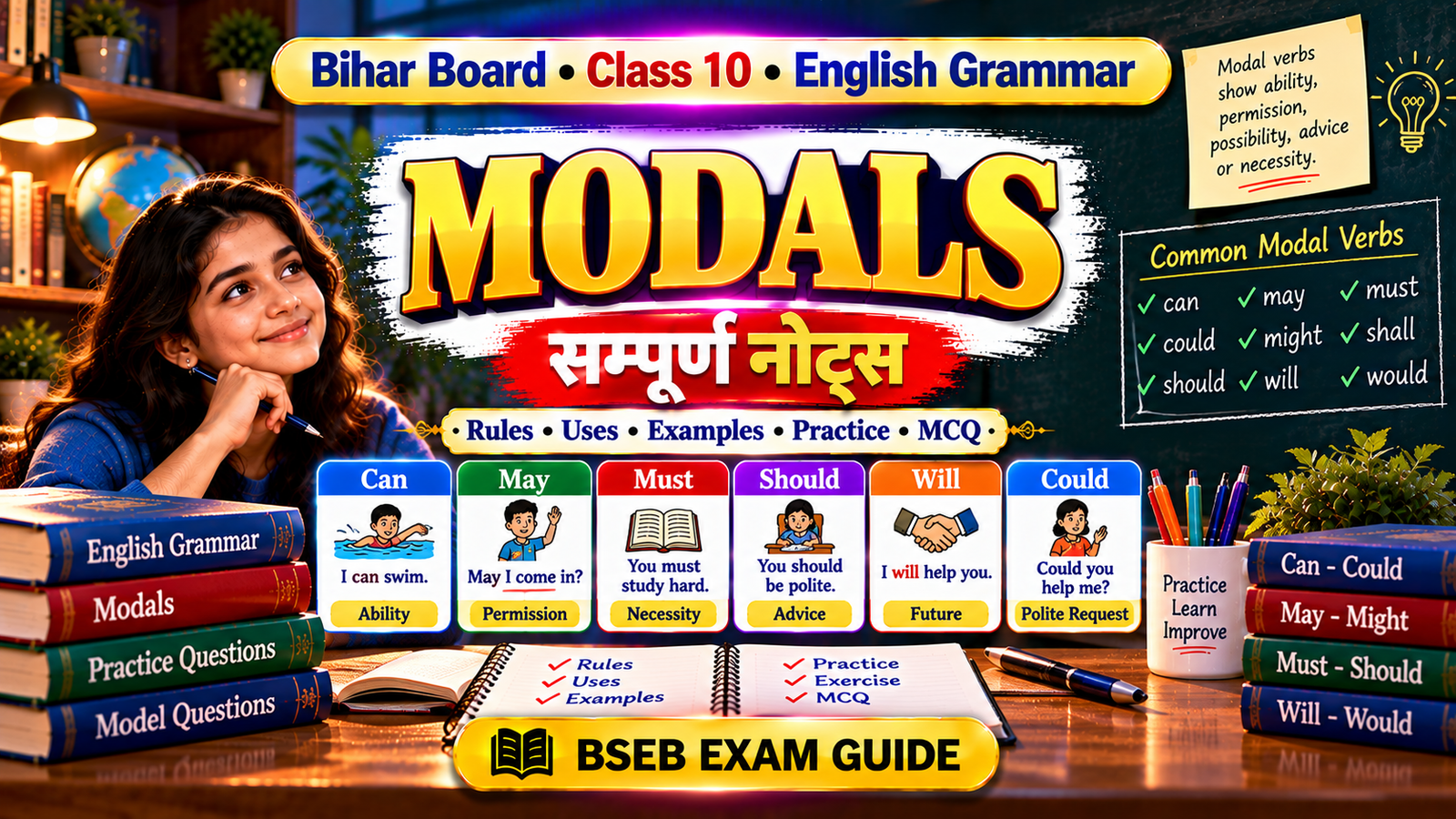
Modals
सम्पूर्ण नोट्स
Rules • Uses • Examples • Practice • MCQ
1. Modals क्या हैं?
Modals ऐसे Auxiliary Verbs हैं जो Main Verb के साथ मिलकर Ability, Permission, Possibility, Advice, Necessity, Obligation, Request, Promise आदि भाव व्यक्त करते हैं।
I can swim.
You should study.
He may come.
We must obey the rules.
2. सबसे महत्वपूर्ण Modal Rule
Modal के बाद Main Verb की First Form (V1) आती है। सामान्य modal construction में verb के साथ s, es, ing या ed नहीं लगाया जाता।
✓ He can play.
✓ She may come.
✓ You should work.
✗ He can plays.
✗ She may comes.
✗ You should worked.
3. CAN – Ability
Can का प्रयोग Present Ability यानी वर्तमान क्षमता बताने के लिए किया जाता है।
I can swim.
She can speak English.
He can solve this question.
4. CAN – Permission
Informal permission माँगने या देने के लिए भी can का प्रयोग होता है।
Can I come in?
You can use my pen.
5. CAN – Possibility
कुछ situations में सामान्य possibility बताने के लिए भी can का प्रयोग होता है।
Accidents can happen.
It can be very cold here in winter.
6. COULD – Past Ability
Could का प्रयोग सामान्यतः past ability बताने के लिए किया जाता है।
I could swim when I was five.
She could read at an early age.
Could → Past Ability
7. COULD – Polite Request
Polite request के लिए could बहुत उपयोगी है।
Could you help me?
Could you open the door?
8. MAY – Permission
Formal permission माँगने या देने के लिए may का प्रयोग किया जाता है।
May I come in, sir?
You may leave now.
9. MAY – Possibility
Possibility बताने के लिए भी may का प्रयोग होता है।
It may rain today.
He may come tomorrow.
10. MAY – Wish / Prayer
Wish या prayer व्यक्त करने वाले sentences में may का प्रयोग हो सकता है।
May God bless you!
May you succeed!
11. MIGHT – Weak Possibility
Might का प्रयोग possibility बताने के लिए किया जाता है, अक्सर जब speaker संभावना को कम निश्चित रूप में प्रस्तुत करता है।
It might rain tonight.
He might come to the party.
12. SHALL – Future / Suggestion
Traditional grammar में shall का प्रयोग I और We के साथ future के लिए मिलता है। Modern English में will बहुत सामान्य है।
We shall meet again.
Question form में suggestion या offer के लिए Shall विशेष रूप से उपयोगी है।
Shall we go?
Shall I open the window?
13. SHOULD – Advice
Advice या suggestion देने के लिए should का प्रयोग होता है।
You should work hard.
You should respect your parents.
We should help the poor.
14. SHOULD – Duty
Duty या उचित कार्य बताने के लिए भी should का प्रयोग होता है।
We should obey the law.
Students should respect their teachers.
15. WILL – Future
Future actions के लिए will का व्यापक रूप से प्रयोग होता है।
I will help you.
She will come tomorrow.
They will visit Patna next week.
16. WILL – Willingness / Promise
Willingness, promise या determination जैसे भावों में भी will का प्रयोग किया जाता है।
I will help you.
I will never forget your kindness.
17. WOULD – Polite Request
Would का प्रयोग polite request और invitation में होता है।
Would you help me?
Would you like some tea?
18. WOULD – Past Habit
Past में बार-बार होने वाले actions बताने के लिए would का प्रयोग किया जा सकता है।
When we were children, we would play in the field every evening.
19. MUST – Strong Necessity
Strong necessity या obligation के लिए must का प्रयोग होता है।
You must obey the rules.
We must follow traffic rules.
You must wear a helmet.
20. MUST – Strong Deduction
Strong logical conclusion के लिए भी must का प्रयोग किया जा सकता है।
He has been working all day. He must be tired.
The lights are off. They must be asleep.
21. MUST NOT का अर्थ
Must not / mustn’t का अर्थ है कि कोई काम करना मना है।
You must not smoke here.
Students must not cheat in the examination.
यह “काम करने की जरूरत नहीं” के अर्थ में नहीं है।
22. Mustn’t और Don’t Have To
Mustn’t
काम करना मना है।
You mustn’t enter.
Don’t Have To
काम करना आवश्यक नहीं है।
You don’t have to come early.
23. Have To
Have to का प्रयोग बाहरी नियम, परिस्थिति या आवश्यकता से उत्पन्न obligation के लिए होता है।
I have to wear a uniform.
She has to attend the meeting.
We had to wait for an hour.
24. Ought To
Ought to का प्रयोग duty, moral obligation और advice के लिए होता है।
We ought to respect our elders.
You ought to help the needy.
25. Need / Need Not
Need necessity से संबंधित है। विशेष रूप से need not का अर्थ होता है — आवश्यकता नहीं है।
You need not worry.
You need not come tomorrow.
26. Used To
Used to past habit या past state बताता है जो अब सामान्यतः जारी नहीं है।
I used to play cricket every day.
He used to live in Patna.
27. Can और May में अंतर
Can
Ability
Informal Permission
General Possibility
May
Formal Permission
Possibility
Wish / Prayer
Can you swim?
May I come in?
28. Should और Must में अंतर
Should
Advice / Recommendation
You should study.
Must
Strong necessity / obligation
You must obey the rules.
Must = मजबूत आवश्यकता / बाध्यता
29. Modal का Negative Form
30. Modal का Interrogative Form
Can you swim?
May I come in?
Should we help him?
Will you come tomorrow?
Could you help me?
31. Important Modal Uses Chart
32. Common Errors
❌ He can plays cricket.
✅ He can play cricket.
❌ She may comes today.
✅ She may come today.
❌ You should to work hard.
✅ You should work hard.
❌ He must to obey the rules.
✅ He must obey the rules.
❌ He can to swim.
✅ He can swim.
❌ We ought respect our parents.
✅ We ought to respect our parents.
33. Practice Questions
Q1. You _____ obey your parents. (moral duty)
Answer: should / ought to
Q2. _____ I come in, sir?
Answer: May
Q3. He _____ swim when he was five.
Answer: could
Q4. You _____ wear a helmet while riding a motorcycle.
Answer: must
Q5. _____ you please help me?
Answer: Could
Q6. It _____ rain today. (possibility)
Answer: may / might
Q7. _____ we go for a walk?
Answer: Shall
Q8. You _____ not smoke here. It is prohibited.
Answer: must
Q9. I _____ speak English.
Answer: can
Q10. You _____ take some rest. (advice)
Answer: should
Q11. _____ you like some tea?
Answer: Would
Q12. You _____ not worry; everything is fine.
Answer: need
34. Objective Questions
1. Modal के बाद सामान्यतः कौन-सी verb form आती है?
A. V1
B. V2
C. V3
D. V-ing
2. Ability के लिए कौन-सा modal प्रयोग होता है?
A. Must
B. Can
C. Should
D. Might
3. Past ability के लिए कौन-सा modal है?
A. Could
B. Must
C. Will
D. Shall
4. Formal permission के लिए उपयुक्त modal है —
A. Must
B. May
C. Should
D. Would
5. Advice के लिए सामान्यतः प्रयोग होता है —
A. Should
B. Can
C. Might
D. Will
6. Strong necessity के लिए प्रयोग होता है —
A. May
B. Could
C. Must
D. Would
7. “_____ I come in, sir?”
A. Must
B. May
C. Should
D. Would
8. “You _____ work hard.” (Advice)
A. might
B. can
C. should
D. may
9. “He _____ swim when he was young.”
A. could
B. must
C. shall
D. should
10. “Would you like some tea?” expresses —
A. Obligation
B. Polite offer
C. Past ability
D. Prohibition
11. “Must not” generally expresses —
A. Permission
B. Advice
C. Prohibition
D. Ability
12. “Need not” means —
A. Strong obligation
B. No necessity
C. Ability
D. Past habit
13. Which is correct?
A. He can plays.
B. He can to play.
C. He can play.
D. He can played.
14. “Shall we go?” expresses —
A. Suggestion
B. Past ability
C. Prohibition
D. Necessity
15. Moral duty can be expressed by —
A. ought to
B. can
C. may
D. might
16. “May God bless you!” expresses —
A. Ability
B. Wish
C. Order
D. Past habit
35. Quick Revision
Can
Ability
Could
Past Ability
May
Permission
Might
Possibility
Shall
Suggestion
Should
Advice
Will
Future
Would
Polite Request
Must
Necessity
Ought To
Moral Duty
Need Not
No Necessity
Modal + V1
Golden Rule
Exam Tip
Modals में पहले sentence का भाव पहचानें। Ability हो तो can, past ability हो तो could, advice हो तो should, formal permission हो तो may और strong necessity हो तो must चुनें।
सबसे जरूरी rule: Modal + V1.